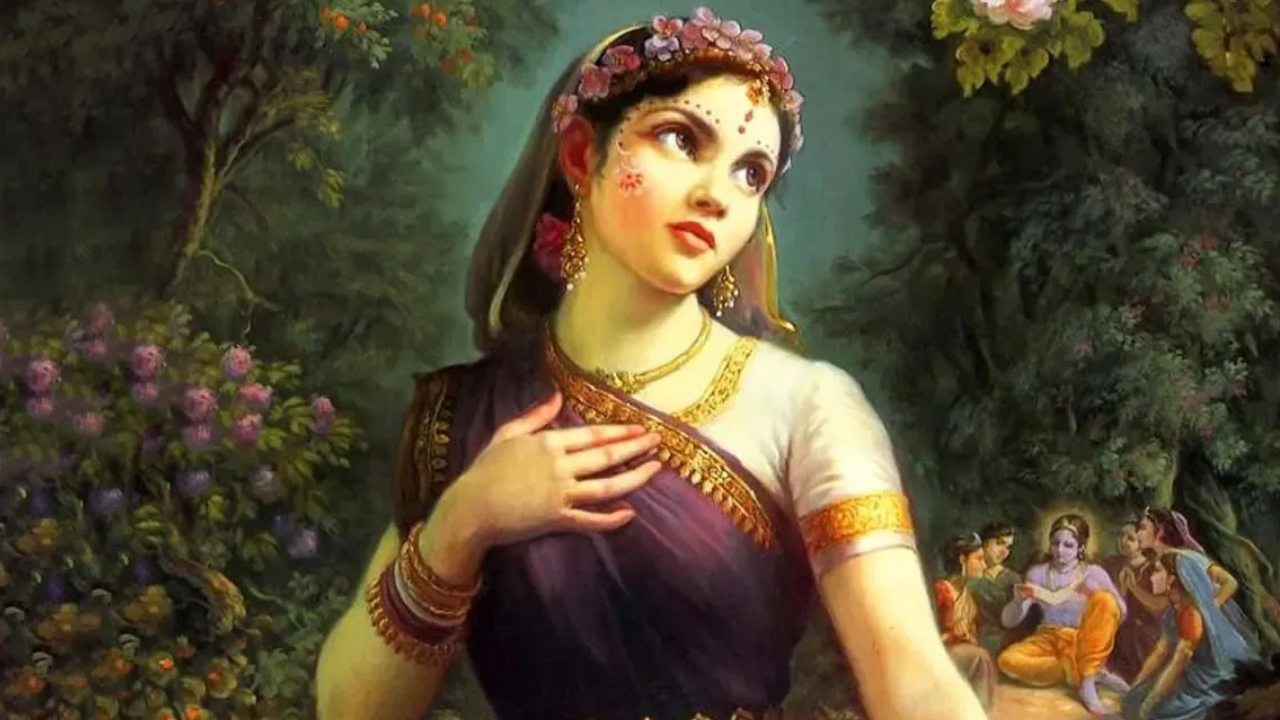
The names of Sri Krishna and Sri Radha are invariably spoken of together, symbolising the eternal bond of divine love and devotion.
While Krishna is revered as the Supreme, Radharani is honoured as His eternal consort, the crown jewel of devotees and the very essence of loving service to Him.
On the auspicious occasion of Sri Radhashtami, the appearance day of Srimati Radharani, this article—authored by Sri Chanchalapathi Dasa, President of Vrindavan Chandrodaya Mandir and Senior Vice President of ISKCON Bangalore,
and published in The Speaking Tree—offers insights into Her exalted position, Her transcendental relationship with Krishna, and why Her worship is of profound significance in the path of devotion, which remains little known to the wider audience.
RADHARANI: KRISHN'S TOPMOST DEVOTEE
Keshav is the absolute Truth, the source of everything, and His pleasure-giving shakti is Radharani, writes CHANCHALAPATHI DASA.
We are a reflection of that absolute Person, absolute Truth, Krishn; we are an aṁśa of Him. And so, whatever attributes we have, He has in their finest form, and to an unlimited extent, Now, what will give Him pleasure?
Since everything is from Him; He is the source of everything.
His pleasure must also come from Him.
The Vedic literature further describe parāsya śaktir vividhaiva śrūyate - the Absolute Truth has multiple energies, but among them, there are three principal ones.
One of them is sandhini shakti, by which He exists.
One of the manifestations of sandhini shakti is His beautiful form. Another is the samvit shakti, which gives Him knowledge.
That means He is not dependent on anything else for knowledge, but only on His own samvit shakti.
The third is the hladini shakti, which gives Him pleasure.
Again, He is not dependent on any external source for pleasure; it comes only from His own hladini shakti.
Thus, Krishn, the all-attractive Absolute Truth, has no origin outside Himself.
He is the source of everything, including us. And this pleasure-giving shakti, another person, is Radharani.
Radha means one who worships, one who serves Krishn. We are propagating the Hare Krishn Mahamantra.
This mantra, mentioned in the Upanishads, has three words Krishn, Ram and Hare. What does the word, 'hare' mean?
It comes from the word 'hara'.
It means 'the one who can captivate. In Sanskrit, a lion is called 'hari'.
Because a lion captures or captivates smaller animals.
The Lord is also called Hari because He is sarva-duhkhānām hānir, meaning He can take away the suffering of all living beings, and so, He is also called Hari.
Now, what about the word hara? Hara also means the same - one who can captivate, one who can carry away, take away.
So, Radharani, the pleasure potency of Krishn captures and captivates the heart of Krishn, and that is why the word 'hara' in the Upanishad's mantra refers to Radharani.
In this mantra, it is a call of the jiva. Hara becomes Hare in the vocative. The word 'hara' refers to Radharani, hladini shakti, who can capture Krishn's heart, and she is addressed in the mantra as Hare.
So, in the Hare Krishn mantra, we are appealing to Radharani, Krishn and Ram, who are all names of the Absolute Truth.
Srila Prabhupada said, "You cannot buy a ticket and come to Vrindavan. You must be blessed by Radharani to come to Vrindavan."
The special thing about devotees of Vrindavan is that they have understood one very important spiritual principle. If you go around Vrindavan, people don't say Krishn, but Jai Shri Radhe!
You will see 'Jai Shri Radhe' written on trees, on boundary walls, everywhere, because if we somehow get blessings of Srimati Radharani, we will get Krishn.
Krishn's most dear devotee is Srimati Radharani; if she blesses, Krishn feels obliged to accept such a devotee. This secret is not so well known, but devotees in Vrindavan have understood, which is why they say, 'Jai Sri Radhe,' and they are always eager to worship Radharani.
Srimati Radharani is not an ordinary woman. She is the transcendental pleasure shakti of the supreme personality, Krishn. This is the theology, philosophy, and position of Srimati Radharani. And so, to worship Radharani and get her blessing is the easiest way to get Krishn.
Radhashtami is on August 31, 2025
How should one handle success and failures in life?
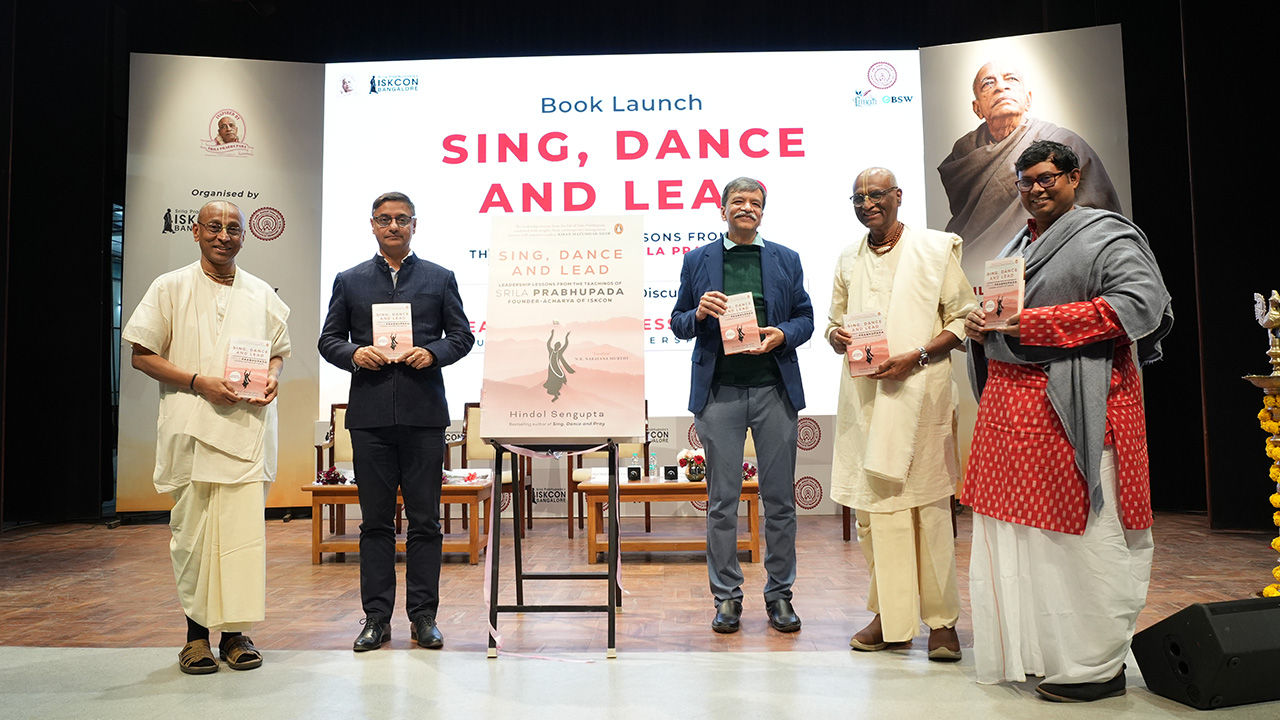
Dr. Hindol Sengupta draws insights from Srila Prabhupada’s unique leadership style in his new book Sing, Dance and Lead.
In today’s fast-paced and competitive world, everyone is working hard to climb the ladder of success.
However, not many know how to deal with challenges and failures that come their way, leading to stress and deterioration of physical, mental and emotional health.
Sing, Dance and Lead, a book by Prof.(Dr.) Hindol Sengupta explores the life and leadership of Srila Prabhupada and offers solutions for maintaining equanimity in all circumstances and for ensuring a healthy mind, body, and spirit.
The book was recently launched at IIT Delhi, one of the premier institutions in India, which is nurturing the brightest minds of our country.
The chilly evening witnessed an auditorium filled with inquisitive young minds, experienced faculty, scholars and professors eager to learn from an eclectic panel of experts discussing the theme, ‘Leading in Success and Failure – Unique Indian Perspectives’.
Shri Sanjeev Sanyal, Member of the Economic Advisory Council to the Prime Minister, Prof. Rangan Banerjee, Director of IIT Delhi, Shri Madhu Pandit Dasa, Founder and Chairman of The Akshaya Patra Foundation and President of ISKCON Bangalore, Shri Chanchalapathi Dasa, Co Founder and Vice Chairman of The Akshaya Patra Foundation and Senior Vice President of ISKCON Bangalore and Dr.Hindol Sengupta, author of the book had a thought-provoking discussion, touching upon various dimensions of leadership that captivated the audience.
The panel discussion was moderated by Dr. Priyanka Kaushal, Professor at CRDT, IIT Delhi.
The conversation opened with the moderator inquiring about Shri Madhu Pandit Dasa’s uncommon journey from being an IITian to becoming a monk who later founded The Akshaya Patra Foundation, recognised as the world’s largest NGO-run school lunch programme, and the inspiration behind this innovation.
As a young graduate from IIT Bombay, Madhu Pandit Dasa had read hundreds of books, seeking answers to profound questions about life, until one day when he hit upon Srila Prabhupada’s book in a library. At first glance, he realised that the book might be the answer to his quest. As he delved deeper into the book, he gradually discovered that it was exactly what he was looking for.
This was the turning point in his life, leading him to renounce the worldly life and to dedicate himself completely to the service of God and humanity.
Inspired by Srila Prabhupada’s life and teachings, Madhu Pandit Dasa accepted Srila Prabhupada as his guru and joined ISKCON in the early 80s.
With the desire to fulfil his spiritual master’s vision that no one should go hungry, he established The Akshaya Patra Foundation, which has served close to 5 billion meals to children studying in government schools, since its inception in 2000.
Speaking about innovation, Madhu Pandit Dasa highlighted that spirituality encompasses utilising everything that is useful for the betterment of humanity. He said science, technology, and management knowledge are all tools to serve a noble cause. He has implemented them across all the projects and initiatives of ISKCON Bangalore.
In connection with the book, appreciating Hindol’s comparison of Maslow’s theory of hierarchy of needs with Srila Prabhupada’s teachings, Madhu Pandit Dasa said, “Our Indian leadership, Indian knowledge, takes one beyond fulfilling one’s destiny, discover who he is, and then broaden his perspective as being part and parcel of entire humanity, and therefore serve the humanity. That brings the greatest satisfaction to the self. This kind of leadership knowledge exists only in India.”
Shri Chanchalapathi Dasa, who has been serving society for nearly four decades, was once a science enthusiast keen about inventions and discoveries.
Like Madhu Pandit Dasa, he also came in touch with Srila Prabhupada’s movement incidentally while pursuing his higher education at the prestigious IISc in Bangalore.
Citing an interesting example from Srila Prabhupada’s teachings – why one should aim to catch a rhinoceros instead of a rabbit while going to a forest - he explained how Srila Prabhupada always emphasised thinking big so that if one succeeds, it would be a great achievement; if one does not, his attempt would still be appreciated.
Linking this example to spirituality, he said, “Spirituality is not actually about limiting ourselves, our thinking.
It is about doing something impactful on a big scale in a very sustainable way to the whole of humanity… Spirituality teaches that we should do our duty very sincerely and earnestly without expecting results.
And then there is a divine force that makes many things happen.”
Shifting the focus from spirituality to economics, the moderator turned to Shri Sanjeev Sanyal to discuss how to handle risks and crises in a leadership position.
Based on his personal experience, he highlighted three important elements that will surely lead one to success.
Firstly, one should have the courage of conviction and a vision.
Secondly, create a team that shares the vision and has the talent to bring it together.
And finally, one should be able to stand firm and not give up, even if things are not going the right way or are completely sinking.
This piece of wisdom will surely benefit young, aspiring leaders to have the right mindset and approach in their work.
Bringing the spotlight to students who are under constant stress and pressure to achieve due to the rapidly advancing world, Shri Rangan Banerjee said it is important to focus more on cooperation than competition. He said that our education system is creating the future workforce.
It is essential that students learn teamwork, find common goals, support each other and rise together.
Sing, Dance and Lead is Dr.Hindol Sengupta’s second book on Srila Prabhupada.
His earlier book, ‘Sing, Dance and Pray’, was a biography that detailed all the phases of Srila Prabhupada’s inspirational life, was well received and became a national best-seller.
When asked what led him to write about Srila Prabhupada’s leadership, he said, “In today’s world, everyone claims to be a pioneer.”
But Srila Prabhupada never claimed that he was inventing anything.
He was in a long, illustrious parampara.
And he was very keen to explain to people that he was only passing on the knowledge that he had received.
His inventions and innovations were only to enhance his ability to spread the divine message of Lord Krishna.
He described Srila Prabhupada as one of the greatest spiritual entrepreneurs the country has ever seen.
At the advanced age of 70, when most people retire, Srila Prabhupada crossed oceans to spread Indian spiritual culture and single-handedly brought about a tremendous revolution in the world.
He also said that anyone aspiring to become a leader or build an institution would find invaluable lessons from the life of Srila Prabhupada.
The engaging conversation was wrapped up with a summary from the moderator, helping the audience recall the insights shared and apply them further in their personal and professional lives.
The essence of the discussion with these eminent leaders was that one should never give up under any circumstances.
The efforts put in with the right mindset and approach will definitely yield results, even if the journey feels demotivating at times.
Sing, Dance and Lead is a must-read for all students, professionals, managers, aspiring leaders and book enthusiasts to learn and imbibe the qualities of an ideal leader from Srila Prabhupada’s life example.
The book is available on e-commerce platforms like Amazon, Flipkart, Crossword and Padhega India.